
Systems and materials
Tree roots in sewer laterals: why redwood country is different
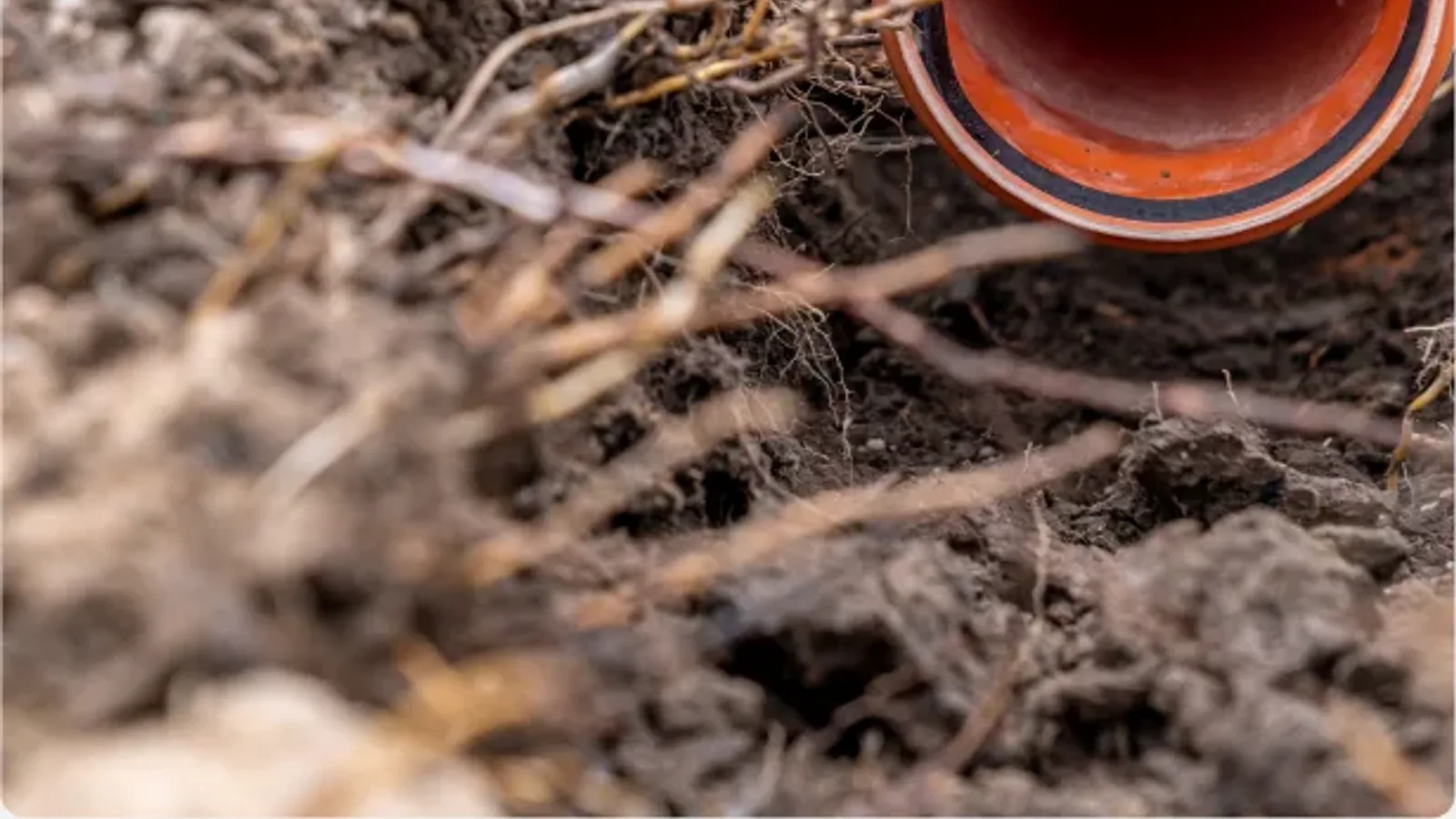
Roots do not break into a sound pipe. They find an existing crack or open joint, follow the moisture escaping from it, and grow in through the gap. The blockage is the symptom; the opening in the pipe is the condition.
How roots actually get into a pipe
A sewer lateral is the buried pipe carrying everything from the house to the sewer main, and it is warm, wet, and rich in nutrients, which describes exactly what a root system spends its life searching for. A sound, sealed pipe gives nothing away. One with a hairline crack or a slightly open joint leaks water vapor into the surrounding soil, and roots grow along that moisture gradient to its source.
What follows the first root hair through the gap is an occupation. Inside the pipe, roots find better conditions than anywhere else in the soil and grow into a dense mat that catches paper, grease, and solids. The blockage everyone notices is that mat plus what it has caught. The gap it grew through was there first, and it is still there after every clearing.
Why it is routine on the North Coast
Three local facts combine into one of the most common service calls in the county. The housing stock is old, so a large share of laterals are clay, laid in short segments with a joint every few feet, and each joint is a candidate opening. The trees are redwoods, alders, willows, and mature ornamentals, all aggressive rooters, growing within reach of those laterals. And the ground itself cooperates: soil that is saturated for months at a time shifts, and shifting soil is what opens clay joints in the first place.
A redwood in the yard is not a sentence, and removing trees is rarely the answer, since roots travel much further than most people expect and a neighbor’s tree serves just as well. The practical conclusion is different: on an older lateral here, roots are the default suspect for recurring drain trouble, and the pipe’s condition is worth knowing before deciding anything.
The early signs, in order of appearance
Root intrusion announces itself gradually, and the sequence is fairly consistent:
- Drains house-wide become slightly slow, and the lowest fixtures gurgle as air moves past a partial obstruction
- A toilet bubbles when the washing machine drains, or the shower backs up when a toilet flushes, which marks a main line rather than fixture problem
- Blockages start recurring on a rhythm, cleared each time and back within months, often worse in spring and fall when root growth surges
- Outside, a patch of lawn above the lateral grows greener and faster than everything around it, fed from below
- Finally, waste backs up at the lowest drain in the house, which is where the story usually stops being ignorable
What clearing does and does not do
A drum machine with a root-cutting head restores flow, usually the same day, and that is the right immediate move for a blocked line. What it leaves behind is the root structure in the joint and the opening it grew through. Regrowth from an established root mass is fast, commonly back within six to twelve months, sometimes sooner in a wet year.
Hydro-jetting cuts and flushes the root mass more thoroughly than a cable does, and on a structurally sound line it buys a longer interval. The caution is the same as for any jetting on old pipe: pressure applied inside compromised clay or cast iron can enlarge the problem, which is one more reason the camera comes first.
What the camera changes
From above ground, a lateral that blocks every year could be lightly invaded at one joint or structurally failing at ten. Those two situations have completely different sensible responses, and only a camera tells them apart. The inspection shows how many entry points exist, how large the root masses are, whether the pipe retains its shape, and where along the run each problem sits, located from the surface so any dig is a surgical one.
| Camera finding | Sensible response |
|---|---|
| Light intrusion at one or two joints, pipe otherwise sound | Clear the line, then manage: scheduled maintenance clearing or foaming treatment, re-camera periodically |
| Heavy intrusion at one location, rest of the run sound | Spot repair: excavate and replace the failed section |
| Roots at many joints, pipe shape still intact | Trenchless lining, which seals every joint at once without a full-length dig |
| Deformed, collapsed, or badly offset pipe | Replacement of the affected run; lining needs a pipe that still holds its shape |
The permanent fixes, honestly compared
Roots enter at openings, so the permanent fixes are the ones that eliminate openings. A modern replacement lateral is continuous plastic with fused or gasketed joints, which offers a root nothing to follow and nothing to enter. Lining reaches a similar end by building a new jointless pipe inside the old one.
The honest trade-offs:
- Scheduled clearing is the cheapest year one and the most expensive decade, and it accepts a recurring risk of backup between visits
- Spot repair is economical when the camera shows one bad section, and pointless when it shows ten
- Lining seals the whole run with minimal digging, at a cost between repair and replacement, and needs a structurally sound host pipe
- Replacement costs the most and ends the subject, which on a collapsing clay line from the 1950s is usually where the arithmetic lands anyway
The wrong outcome is the common one: paying for clearing after clearing for years, then paying for the replacement anyway. The camera inspection after the second blockage is what breaks that pattern, because it converts the decision from a guess into a comparison of known options.
A note for buyers and sellers
A sewer lateral inspection is one of the highest-value checks in a local home purchase, for the same reasons this article exists: old laterals, big trees, moving ground. A camera inspection before closing prices the pipe into the deal, in either direction. For sellers, a recent inspection video of a sound or newly replaced lateral answers the question before it is asked.
Common questions
It restores flow, and the roots return, commonly within six to twelve months, because the opening they grew through is still there. Cutting is the right emergency response and a legitimate ongoing maintenance choice, but only sealing or replacing the pipe ends the cycle.
Usually not. Roots travel far further than the canopy suggests, so a neighboring tree can reach the same lateral, and removal does not close the opening in the pipe. Fixing the pipe addresses the cause; the tree is just the messenger.
Poorly, in most real lines. Flushed crystals largely bypass the root mass, the product is hard on septic systems, and it does nothing about the opening the roots used. Professionally applied foaming treatments manage regrowth better, and neither substitutes for repairing the pipe.
A camera inspection. It travels the lateral from a cleanout, shows every root entry and the condition of the pipe, and locates problems from the surface. Recurring main line blockages, gurgling fixtures, and a green stripe in the lawn are the signs that make it worth doing.
More from the knowledge base
Still stuck?
Describe what you are seeing and we will tell you whether it needs looking at now or can wait.